
Atmospheric thirst: Longer droughts, more wildfires
As Trump and allied neanderthals deny climate change, the science of AED stands.

It’s not just lack of rainfall that causes drought that causes horrific wildfires. It’s AED — that is, atmospheric evaporative demand, or what climate scientists call “atmospheric thirst,” the rate at which ground moisture evaporates.
It was an American climatologist, C. W. Thornthwaite, and a British meteorologist, Howard Penman, who published early research on evaporation rates and established formulas to predict their effects on agriculture and natural resources. Those scientists of the 20th Century — Thornthwait died in 1963, Penman in 1984 — might be shocked by the acceleration of AED in the 21st Century.
AED has accelerated with global warming caused by climate change caused by human activity.
Research published last year in the British journal Nature found that drought severity has increased steadily worldwide since the start of the 20th Century. “Our findings suggest that AED has increased drought severity by an average of 40% globally,” researchers reported. “Not only are typically dry regions becoming drier but also wet areas are experiencing drying trends.”
Warm air is a primary factor in AED, sucking moisture from farm fields, forests, rivers, reservoirs and lakes. Winds bring dry air that absorbs more moisture. The sun plays a big part, too.
Because of the increase in temperatures globally, we are seeing longer droughts and more wildfires, like those in Spain and France, Canada and the U.S.
In five recent years (2018-2022), said the Nature article, areas in drought were 74% greater than those recorded from 1981 to 2017. And AED was the major factor in that increase.
“The year 2022 was record-breaking, with 30% of the global land area affected by moderate and extreme droughts, 42% of which was attributed to increased AED,” researchers said. “Our findings indicate that AED has an increasingly important role in driving severe droughts and that this tendency will likely continue under future warming scenarios.”
Damian Carrington, the Guardian’s environment editor, notes that western Europe’s most recent winter was a wet one. High temperature, and not precipitation, is now the key factor in drought there. What’s happening in western Europe, with extreme heat waves and drought, would have had only a moderate effect on life before the climate crisis.
AED is happening at a higher rate in the U.S. as well; droughts are lasting longer here than they did 20 years ago. If government websites can still be believed under the Trump regime, more than 38% of the nation is experiencing drought at this writing; that includes 205 million acres of croplands.
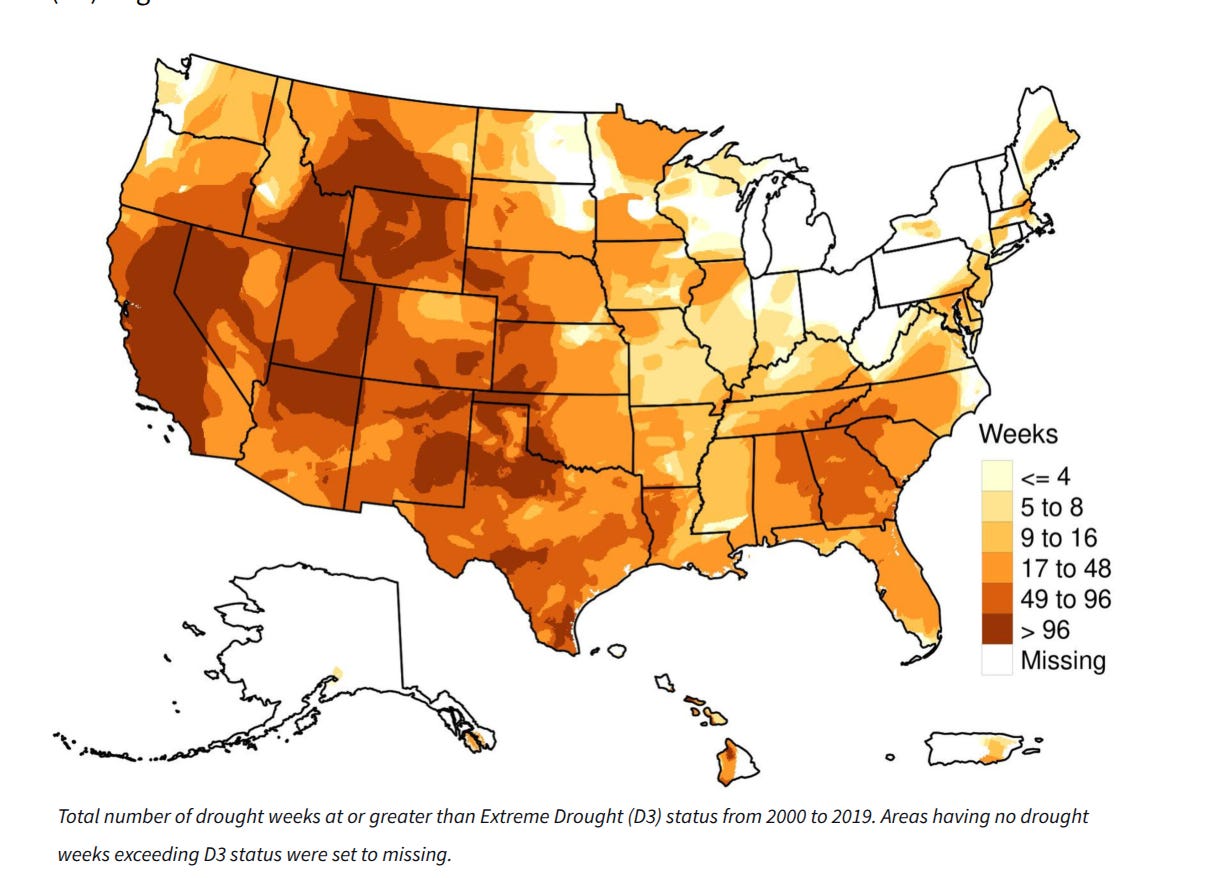
Given our continued burning of fossil fuels, the Trump regime’s war on science and its shutdown of the nation’s climate response, things will not be getting better here any time soon.
“Climate change and a ‘thirsty atmosphere’ will bring more extreme wildfire danger and multi-year droughts to Nevada and California,” according to research from Nevada’s Desert Research Institute (DRI) and the University of California. “Climate change projections show consistent future increases in AED over California and Nevada. These changes were largely driven by warmer temperatures, and would likely lead to significant on-the-ground environmental impacts.”
Foundational climate research, going back to Thornthwaite and Penman, provided ways for humanity to better see particular atmospheric conditions and even predict their effects on lands where we live and grow food and on the waterways necessary to sustain life. Since then, the overwhelming majority of the world’s climate scientists have concluded that greenhouse gases from fossil fuels have heated the Earth and caused extreme weather — storms, droughts, heat waves and wildfires.
In the midst of this, we have Trump and his neanderthal allies, dismissing science and all that earnest research, denying climate change and promoting 20th Century solutions to our 21st Century energy needs. The U.S. stands among the world’s top consumers of fossil fuels and materials per capita, and yet the national government’s response to global warming has stopped.
Meanwhile, the climate clock keeps ticking.
Some people describe the next two elections as matters of life and death for democracy. We should amend that statement to add the words “ . . . and for the planet.”
Excellent as usual. Thanks for highlighting this important (indeed crucial) topic. As a non-specialist scientist (I'm an astronomer, not a climate scientist per se), I've given numerous public talks on climate change, trying to communicate the basics of the science and the urgency about the need for action. It gives me no pleasure to say "we" (the scientific community) told you so, but we have tried.
Unfortunately, I do partly blame us scientists for not finding a way to communicate it better. One or two degrees of increase in global temperature sounds small, but it is a huge change! The basic concept is more heat-trapping gases in the atmosphere drive our environment out of the current balance and into a new equilibrium, one that is not as favorable for us 8 billion+ humans. We are playing with fire and gasoline.
One little quibble about "...and for the planet" at the end of your piece--the planet will still be here and will survive just fine. It just will not be as suitable for our survival, along with the many other species that are already being impacted.
AED is a new term for me but the story of how climate denialists promote oil & coal consumption is not new. Don't they care about the world they are leaving their children and grandchildren?